· on this page
An invoice looks simple, a header, a list of things, a total, and a request for payment. But every field on it serves a specific function. Skip one and you get paid late, get your books questioned, or worse, lose the ability to collect on an unpaid balance.
This guide covers what an invoice legally needs, what it practically needs, and how to put one together in under five minutes. Every example uses our free invoice generator, but the structure applies regardless of which tool you use.
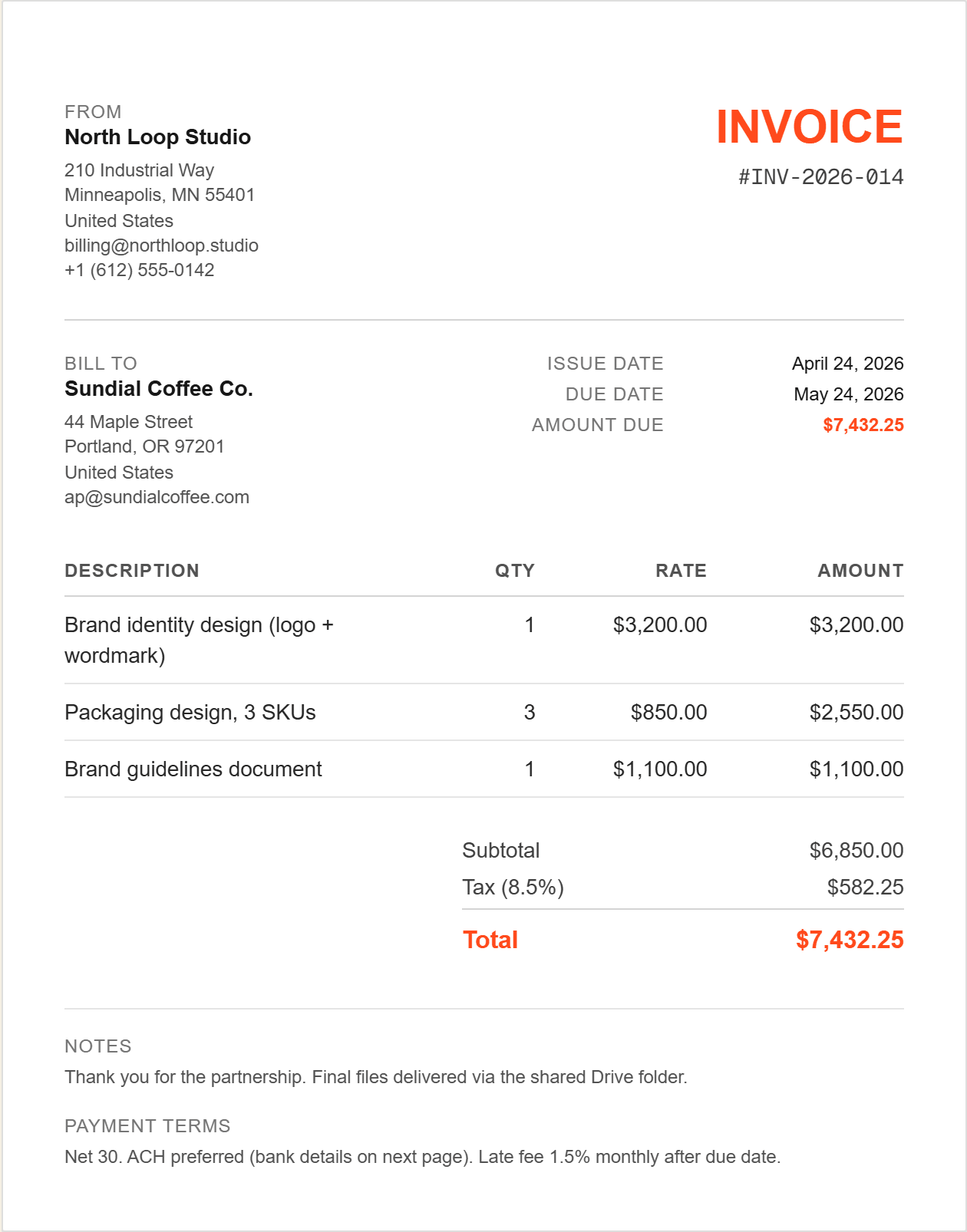
What counts as an invoice
An invoice is a document from a seller to a buyer that requests payment for goods or services, on specific terms, at a specific time. It creates an account receivable on your side and an account payable on theirs. In most jurisdictions it's the primary legal record of a commercial transaction for tax, audit, and dispute purposes.
A receipt is different, that's proof the payment happened, issued after the fact. A quote or estimate is also different, that's a proposal, not a demand. A statement lists multiple invoices but isn't one itself. Use the word Invoice clearly at the top of the document; the specific word matters legally and operationally.
The 8 required fields
Missing any of these slows down payment or opens disputes. In roughly the order they should appear:
- The word "Invoice"at the top. Not "Bill," not "Statement," not your logo with no title. Accounts-payable systems scan for this literal word; without it some systems reject the document.
- A unique invoice numbersequential, never reused. Common formats: INV-001, INV-2026-001, YYYYMMDD-01. Tax auditors check that numbering is gap-free; reused numbers are treated as accounting errors or, worse, fraud.
- Issue date and due date, bothThe issue date is when the invoice goes out; the due date determines when you can start charging late fees. "Due upon receipt" without a specific date is legally weak, state an actual calendar date.
- Your business detailslegal business name (not a DBA unless registered), mailing address, email, phone. Add your tax ID, EIN, or GST/VAT registration number if your jurisdiction requires one for tax-compliant invoices.
- Client billing informationlegal name exactly as it appears on their AP records (not just the person who hired you). Wrong entity name is the #1 reason invoices sit unpaid, the client's AP system can't match it to a purchase order.
- Itemized linesdescription, quantity, rate, subtotal per line. Never lump items ("design work, $3,000" invites scrutiny; "logo concepts, 3 rounds at $500 = $1,500" sails through).
- Totals broken outsubtotal, tax (as its own line with the rate shown), discount (if any), grand total with currency code. Never roll tax into the item price; the buyer needs it separately for their books.
- Payment terms and accepted methodsNet 30, late-fee rate (e.g., 1.5% monthly), and how to pay (bank transfer details, payment link, Wise email, check mailing address). Don't make the client ask.
Step by step: your first invoice
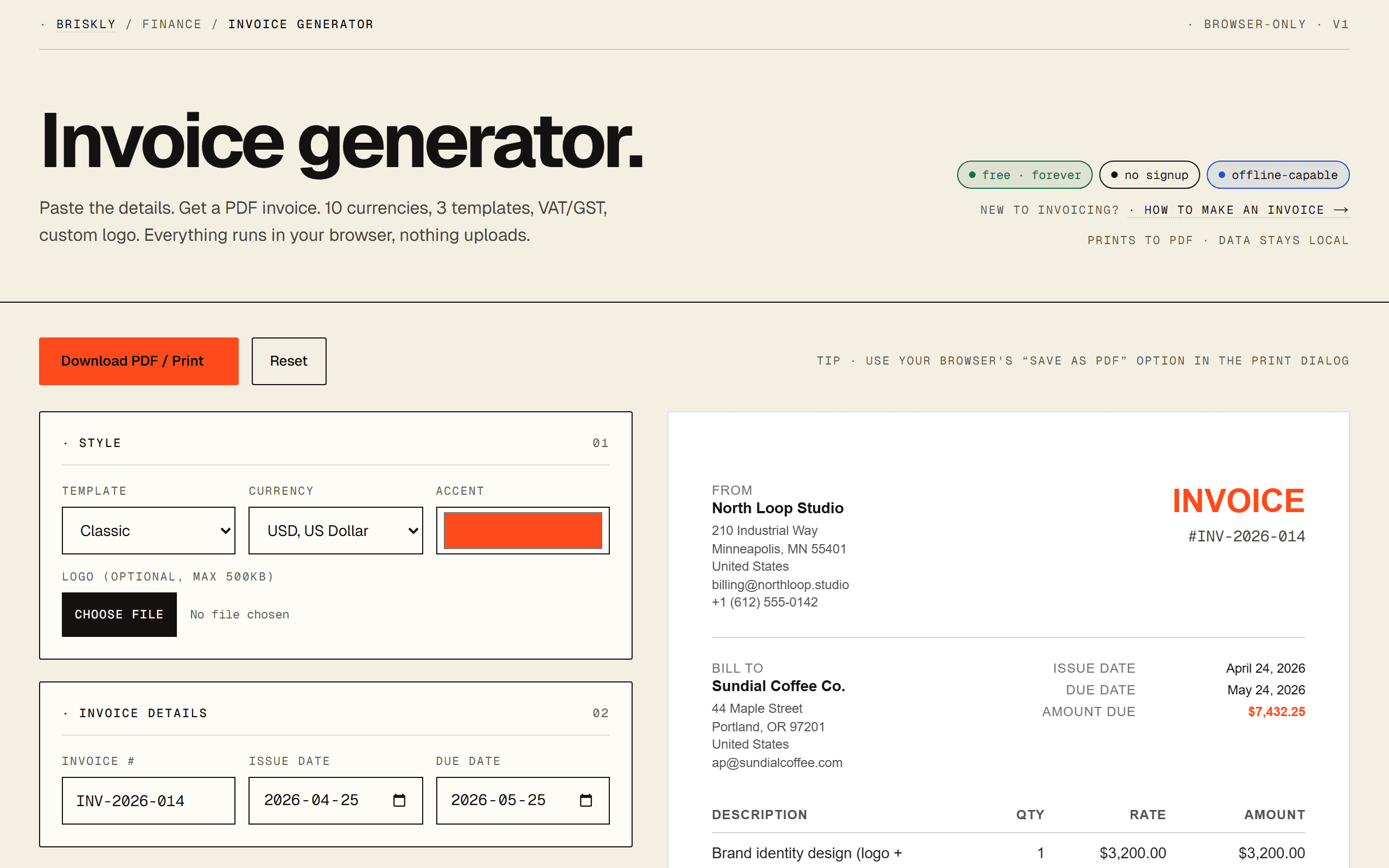
If you're doing this for the first time, walk through this order. Open the invoice generator in another tab and follow along.
· The 8-step flow
- StylePick a template (Classic is fine for 99% of cases), currency, and accent color. Upload your logo if you have one, the tool saves it to your browser for next time.
- Invoice detailsAssign a number. If this is your first ever invoice, INV-001 is fine. Pick today's issue date and 30 days out for due date.
- FromYour business. Double-check the name matches your legal entity. Include your tax ID here if needed.
- Bill toYour client. Ask them for the exact billing entity name and address before the first invoice; this saves two weeks of back-and-forth later.
- Line itemsOne row per deliverable. Hours × rate, or fixed fees per milestone. Click "add line" for as many as you need.
- Totals adjustmentsEnter your tax rate if it applies. Leave at 0 if not (most US service work, for example).
- Notes & termsState how to pay. Example: "Pay via bank transfer to the account details above, or Wise to pay@yourbusiness.com. Late payments subject to 1.5% monthly interest after the due date."
- Download PDF / printClick the button and "Save as PDF." Email the PDF to your client's accounts-payable contact, attach the file, don't link it.
Invoice numbering conventions
There's no universal standard, but there are patterns that age well. Pick one and stick with it from day one.
- Simple sequential. INV-001, INV-002, INV-003. Simplest to track. Fine until you cross 1,000 invoices or multiple years.
- Year-prefixed. INV-2026-001. Resets each year. Easy to audit. Clean for annual tax reporting.
- Date-based, 20260419-01 (YYYYMMDD-sequence). You can tell exactly when each invoice was issued from the number. Useful if you bill daily.
- Client-prefixed. ACME-2026-001. Good if you have a handful of large clients; makes the number speak for itself during follow-ups. Bad if you have many clients (too many number series to track).
Payment terms that actually work
Payment terms set the legal clock on when you can charge late fees or escalate. Vague terms are unenforceable.
- Net 30, standard. Payment due 30 days from the issue date. Most corporate clients expect and enforce this.
- Net 15, tighter. Good for new clients or freelancers managing cash flow.
- Due on receipt, payment expected immediately. Only realistic if your client pre-pays or has signed an agreement specifying it.
- 50/50 deposit, 50% up front to start work, 50% on delivery. Industry standard for bigger projects (usually $5K+).
- Milestones, e.g., 25% at 4 defined checkpoints. Best for multi-month projects where scope can change.
Sending the invoice
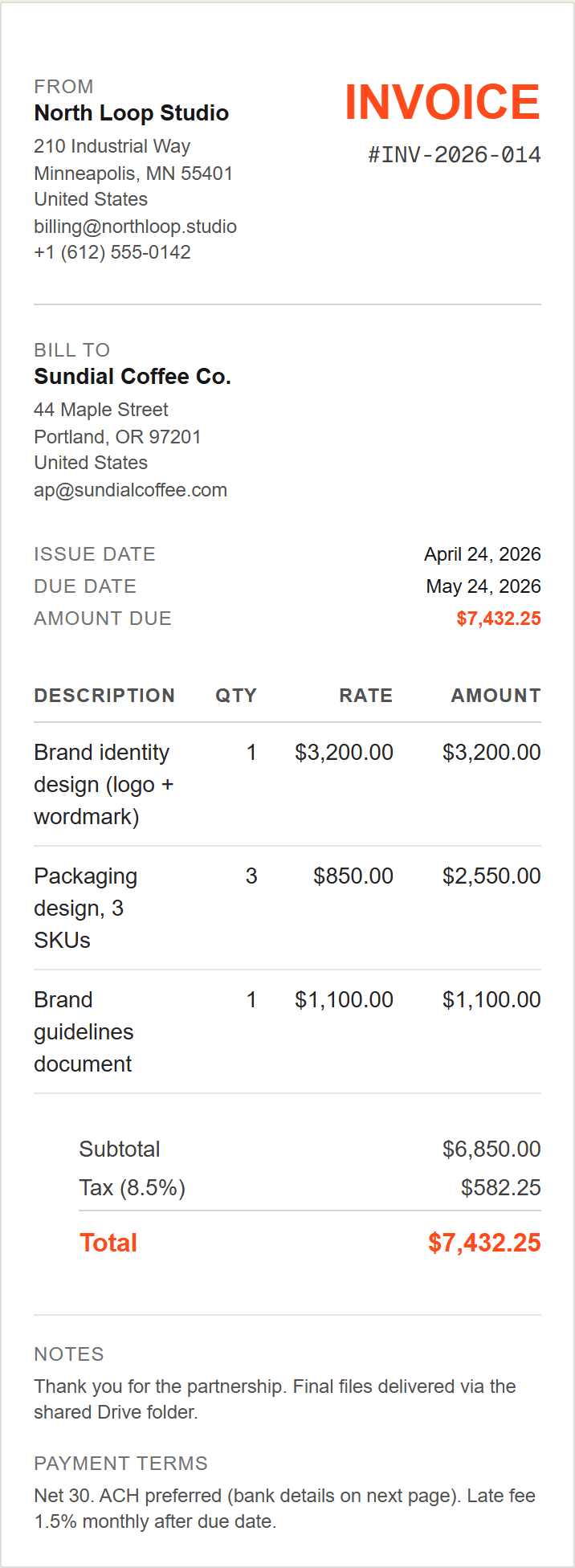
The document is done; now the logistics. Three things matter:
- Send as a PDF attachment, never as a Word or Excel file. PDF is locked so the client can't accidentally (or intentionally) edit line items. AP systems archive PDFs natively.
- Email the AP contact, not just the person who hired you, project managers rarely pay invoices. Ask for the accounts-payable email address during the intake process; it's saved you a week before you even send.
- Use a clear subject line, include the invoice number and client name or project name: "Invoice INV-2026-001, [Project Name], [Your Business]". Vague subject lines ("invoice for you") get buried.
Following up on unpaid invoices
Most overdue invoices are oversight, not refusal. Your follow-up cadence should escalate slowly, pressure before accusation.
- Day 1 after due date, friendly reminder email, reattach the PDF, assume the best ("wanted to check if this landed in the right inbox").
- Day 7 overdue, more formal. CC the original signer (not just AP). Reference the specific due date.
- Day 15 overdue, phone call. Restate the late-fee terms. Get a specific commitment date.
- Day 30+ overdue, formal demand letter. For amounts over a couple thousand dollars, consider a collections agency or small claims court. Reference all the communications up to this point.
FAQ
What's the minimum I need to include on an invoice?
Eight things, every time: the word 'Invoice,' a unique invoice number, the issue date, your business name and contact info, the client's billing name and address, an itemized list with quantities and rates, the total (with tax shown separately), and clear payment terms. Missing any of these will delay payment or cause disputes.
Do I have to use a specific invoice number format?
No, but it must be unique and sequential. Common formats: INV-001, INV-2026-001, 20260419-01 (YYYYMMDD-sequence). Don't reset the sequence mid-year unless you include a year prefix. Tax authorities and auditors check that your numbering is consistent and gap-free.
What are standard payment terms for a new freelance client?
Net 30 is the traditional default. For a new client with no payment history, Net 15 or 50% deposit + 50% on completion reduces your risk. Always state late-fee terms (e.g., 1.5% monthly) and the specific due date, 'payable upon receipt' without a date is legally weak.
Do I need to charge tax on my invoice?
Depends on your jurisdiction and what you're selling. US services are usually tax-exempt (with exceptions, check your state); US physical goods almost always incur sales tax. Canada requires GST/HST/PST once you cross $30K/year. UK and EU require VAT past their registration thresholds. When unsure, ask your accountant before sending the invoice, fixing tax errors after the fact creates real liability.
Can I send an invoice before completing the work?
Yes, and for larger projects you should. Common patterns: 50% deposit up front + 50% on delivery; milestone billing (e.g., 25% at 4 defined checkpoints); monthly retainer invoices at month-start. Cash flow is the first thing that kills new freelancers, don't wait until the whole job is done for any project over a couple weeks.
What's the difference between an invoice, a bill, and a receipt?
An invoice is a request for payment (you send one, it creates an account receivable). A bill is informal language for the same thing, often used by service providers (utility bill, phone bill). A receipt is proof payment was received (issued after payment, not before). Each word has a specific legal and accounting meaning, use 'Invoice' on the document.
How do I follow up on an unpaid invoice?
Day 1 after due date: friendly reminder email with the invoice reattached. Day 7: more formal follow-up, escalate CC to a second contact at the client (usually the signer, if you've been emailing AP). Day 15: phone call, reference your late-fee terms. Day 30: formal demand letter, consider collections for larger amounts. Most late invoices are oversight, not refusal, pressure before accusing.
Keep reading
- · How to invoice a client (first time), the communication and scope side of the same problem.
- · Invoice vs. receipt vs. bill, when each word matters, legally and practically.
- · Invoice generator, make your first one now. No signup, no watermark.
- · Freelance rate calculator, work backwards from your take-home goal to the rate that gets you there.