· on this page
The short version: invoice = request for payment; bill = informal word for invoice (mostly for consumer-facing services); receipt = proof payment was received. They're not interchangeable, and each serves a specific spot in the money flow.
Quick comparison
| Field | Invoice | Bill | Receipt |
|---|---|---|---|
| Purpose | Request payment | Request payment | Acknowledge payment |
| Issued when | Before payment | Before payment | After payment |
| Typical context | B2B, freelance, pro services | Consumer services, utilities, restaurants | Retail, any completed transaction |
| Creates | Account receivable | Account receivable | Payment record |
| Numbered uniquely? | Yes, always | Usually yes | Yes (ties to invoice #) |
| Due date shown | Yes | Yes | No |
| Legal weight | Enforceable debt | Enforceable debt | Payment proof |
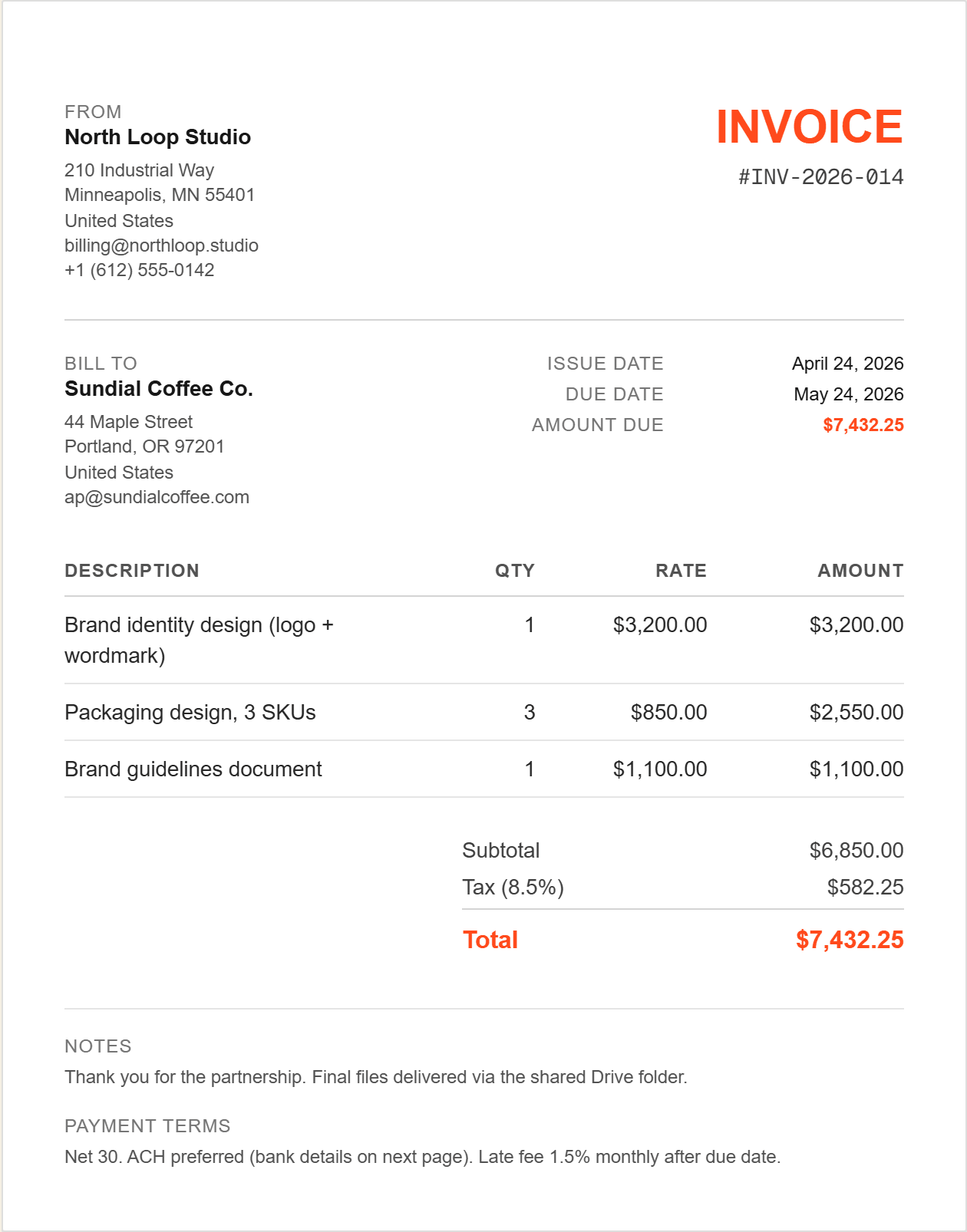
Invoice
An invoice is a formal demand for payment issued by a seller to a buyer under agreed terms. It lists what was sold, how much, when payment is due, and how to pay. The word carries legal weight: tax authorities in most countries require invoices for commercial transactions above a threshold, and invoices are the primary document used in disputes, audits, and collections.
Invoicing is what a freelancer, consultant, agency, contractor, wholesaler, or any B2B seller issues to their clients. It creates an account receivable (the money is owed to you) and the buyer's account payable.
Bill
A bill is a casual, consumer-facing word for the same thing, a request for payment. Utility bill, phone bill, restaurant bill, medical bill, credit-card bill. Functionally, it creates the same obligation as an invoice; linguistically, it signals a recurring or ongoing service rather than a one-time professional engagement.
A freelancer rarely calls their document a "bill", it reads as informal. A dentist's office might call the document they hand you a "bill" rather than an invoice, because the service relationship is less contractual-professional than restaurant-transactional.
Receipt
A receipt is the opposite side of the invoice, it's proof that payment has been made. No amount is owed after a receipt is issued. The receipt documents what was paid, when, and how.
In B2C retail, receipts are what you get at checkout; legally they're required in most jurisdictions for sales above a small threshold, both for consumer protection and tax remittance. In B2B, receipts are less common as standalone documents; the combination of the invoice + the payment record (bank transfer, wire confirmation, check image) usually suffices.
Which word to use
If you're a freelancer, agency, contractor, or any B2B service provider: the document you send before getting paid is an Invoice. Put that word at the top. If the client pays and asks for confirmation, issue a Receiptreferencing the original invoice number. "Bill" is almost never the right word in professional contexts.
FAQ
Is an invoice the same as a bill?
Functionally yes, legally yes, but the language implies different contexts. 'Invoice' is B2B / professional / contracted (a freelancer sends an invoice). 'Bill' is consumer / ongoing service (a utility, a restaurant, a phone company sends a bill). Both request payment; both create an account receivable for the sender and an account payable for the receiver. When in doubt, put 'Invoice' on the document, it carries more formal weight.
Can a receipt serve as an invoice?
No. A receipt is issued after payment; an invoice is issued to request payment. They're mutually exclusive, you can't owe money on a receipt. Some POS systems print a document labeled 'Receipt' that functions like an invoice (especially in B2C retail), but tax authorities typically don't treat it as an invoice for accounting purposes. If you need the money, send an invoice. If payment already happened, issue a receipt.
Do I need to issue a receipt after every invoice gets paid?
Depends on the client and jurisdiction. Most clients don't require a receipt separately, the combination of your invoice + their bank transfer record is sufficient proof of payment. But if the client asks for a receipt (some corporate AP teams do, some tax jurisdictions require it for cash payments), generate a simple 'Receipt. Invoice INV-001 paid in full on [date] via [method]' document. It's not legally mandatory in most US/UK/Canada contexts.
What's a statement? Is that the same as an invoice?
No. A statement is a summary of multiple invoices, usually a monthly list of everything you've billed the client, what's paid, and what's still outstanding. Landlords send statements; suppliers send them to long-term accounts. A single statement can reference many invoices, but it's not itself a demand for payment on any specific one. The underlying invoices are the enforceable records.
If I use the wrong word on my document, can the client refuse to pay?
Practically, no, the contents decide the meaning, not the word in the header. If you send a document titled 'Bill' that includes everything an invoice needs, a court will treat it as an invoice. That said, many corporate AP systems literally scan for the word 'Invoice' and route based on that. Using the wrong word won't cost you the contract but might delay payment by two weeks while their system flags it for manual review. Use 'Invoice.'
Keep reading
- · How to make an invoice, required fields and numbering conventions.
- · How to invoice a client (first time), what to collect before the job starts.
- · How to invoice as a freelancer, the freelance-specific version of the invoicing playbook.
- · Invoice generator, make an invoice that uses the right word and has the right fields.