· on this page
Freelance invoicing is mostly the same as regular business invoicing, with three differences that matter: you're invoicing as an individual or a one-person entity (which changes the tax fields), your clients vary wildly in how fast they pay (which changes your strategy), and you don't have an AP department or bookkeeper picking up the slack (which changes what you have to track). Get those three right and you get paid on time. Get them wrong and you spend two hours a week chasing money.
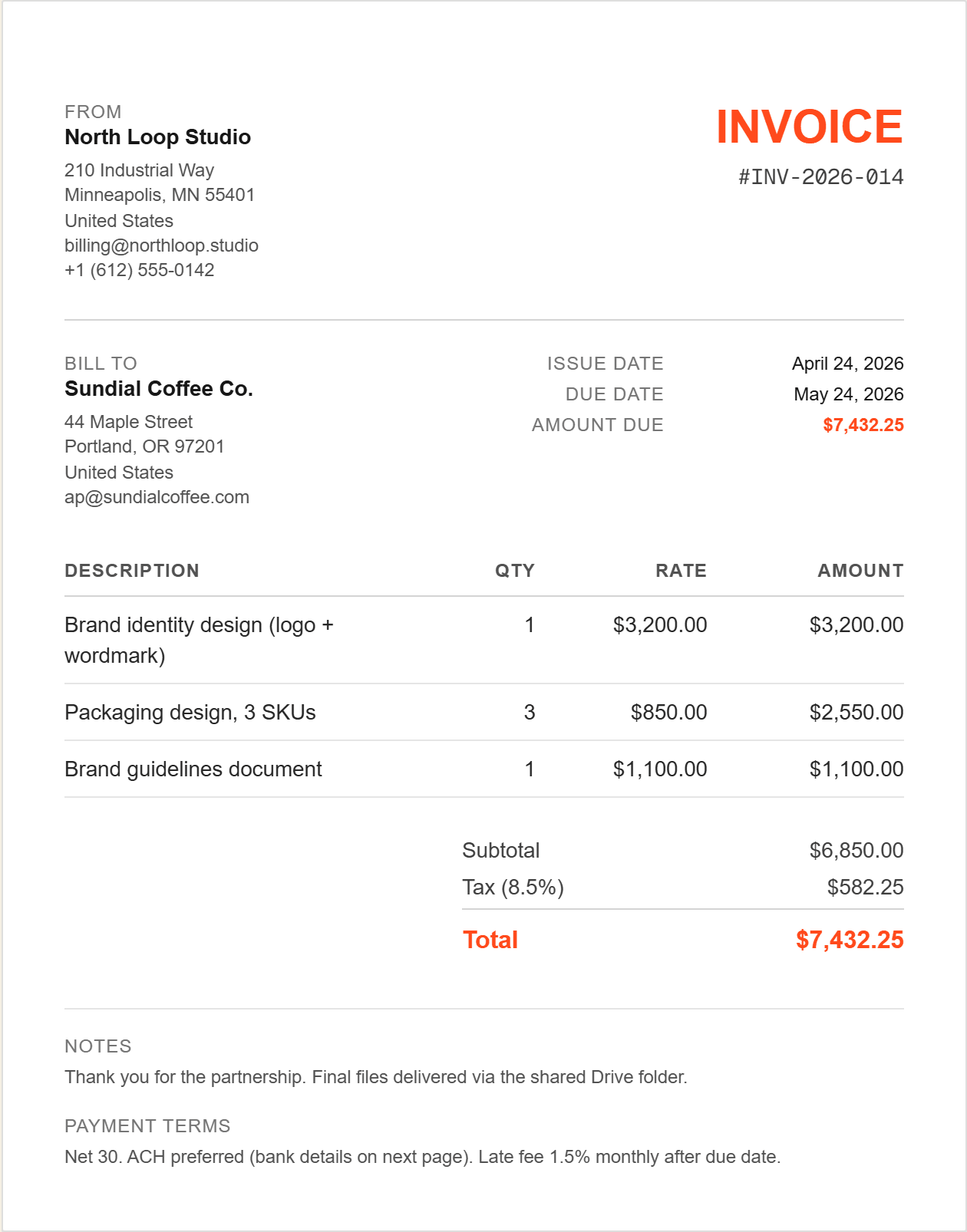
What goes on a freelancer invoice
· The 9 required fields
- Your legal name and addressMatch exactly what's on your W-9 / business registration / HST return. Not your preferred name, not your brand, the legal version.
- Client's legal billing name and addressWhoever signs the contract is often not who pays the invoice. Ask for the correct billing entity before the work starts; "Acme Inc." and "Acme LLC" can be separate tax entities.
- Unique invoice numberSequential, no gaps. INV-2026-001 or CLIENT-001 both work. Gaps get flagged in audits.
- Invoice date and due dateBoth explicit. "Net 30" is ambiguous if you don't spell out which date you're counting from.
- Itemized workOne line per deliverable or time block. Lumped items trigger AP review and delay payment.
- Subtotal, tax, discount, totalEach as its own line. Clients want to see the math.
- Payment methodsBank transfer (ACH / wire / Interac / SEPA) is usually cheapest; credit cards via Stripe/Square cost you 2.9% but often get paid faster. PayPal costs 2.9% plus gets held for US $10K+ amounts. Explicit is better than implicit.
- Your tax IDEIN or SSN (US), GST/HST number (Canada), VAT (UK/EU), ABN (Australia). The client's AP needs this to 1099 you or to reclaim VAT. Missing ID = delayed payment.
- Late-fee policy"1.5% per month on overdue balances" or similar, only enforceable if it was in the original agreement, but even the stated threat tends to move payment up the queue.
Four invoicing models, one invoice structure
Freelancers bill in four common patterns. The invoice structure above works for all of them; only the line-item content changes.
- Hourly. One line per time block (or one line per day with hours summed). Include dates. For clients who want it, attach a separate time log. Our freelance rate calculator helps set the right hourly number.
- Project / fixed-fee. One line for the full project, or split by milestones. Milestone billing (33% start / 33% middle / 34% end) is standard for projects over $5K; protects you from non-payment and protects them from no-delivery.
- Retainer. Monthly recurring with the same amount. Line item is usually just "Monthly retainer, [Month Year]" with the agreed-on scope noted. Invoice on the 1st, due on the 15th is typical.
- Mixed (most common in practice). Retainer line + hourly overages + any out-of-scope add-ons. Itemize clearly so the client can see what was inside retainer vs. what was extra. This is where most disputes happen.
Payment terms that actually get paid
Payment terms are a negotiation, not a default. The table of what actually works for freelancers in 2026:
| Client type | Ask for | Expect |
|---|---|---|
| Small startup / solo founder | Net 7 or Net 15 | Usually pays on time if invoice is clear |
| Mid-size ($10-500M revenue) | Net 30 | Net 30 or slightly later |
| Enterprise (Fortune 1000) | Net 30 | Net 45-60 is common; Net 90 happens |
| Agency (intermediary) | Net 30 on YOU, not on their client | Often they pay when they get paid, push back on this |
| New client, any size | 50% deposit on start | Most pay; if they won't, walk |
The follow-up cadence that works
If an invoice is due today and the money isn't in your account tomorrow, don't panic. Follow a schedule, send every email, keep copies of everything.
- Day 0 (due date): no action. Most enterprises process payments in weekly batches; being a day late is normal.
- Day 7 overdue: friendly nudge. "Hi [name], just checking on invoice #X. Let me know if you need anything from me to process it." Assume incompetence, not malice, usually the invoice got stuck in someone's inbox.
- Day 14 overdue: firmer. Reference the terms, mention late fee if applicable. Ask for a specific pay date.
- Day 30 overdue: formal demand letter, email + certified mail. State the specific deadline (typically 10 more days), state what happens if not met (collection, small claims, lien).
- Day 45-60 overdue: last-resort action. Small claims court (US: $5-10K jurisdictional limit typical; Canada: varies). Or send to a collections agency for 25-40% of the collected amount. Or write off and stop working with that client.
Most of your unpaid invoices get paid at step 1 or 2. It's almost always process failure, not a deadbeat client. Act accordingly.
Tax considerations that trip freelancers up
- W-9 / 1099 (US). Your US clients need a W-9 from you before they pay. If you invoice $600+ in a year, they'll send you a 1099 (actually 1099-NEC now). Keep them, the IRS cross- references them to your reported income.
- T4A (Canada). Canadian equivalent. Some clients file T4As, some don't. Either way, you're responsible for reporting all freelance income on your T1 and filing GST/HST if over $30K/year.
- Sales tax / VAT / GST. If you're registered, include it as a line item. If you're not registered, don't charge it. The gray zone is whether certain services are taxable at all; check your jurisdiction or ask an accountant for year one.
- Foreign clients. A US freelancer invoicing a UK client doesn't charge UK VAT. A UK freelancer invoicing a US client doesn't charge UK VAT. Currency: quote in your home currency to avoid FX surprises on your end.
- Quarterly estimated taxes (US). Freelance income isn't withheld at source. You're expected to pay estimated taxes quarterly (April 15, June 15, Sep 15, Jan 15). Underpayment triggers penalties. Set aside 25-30% of every invoice for taxes; more if self-employment tax brings you to 35%+.
If you just want the free tool
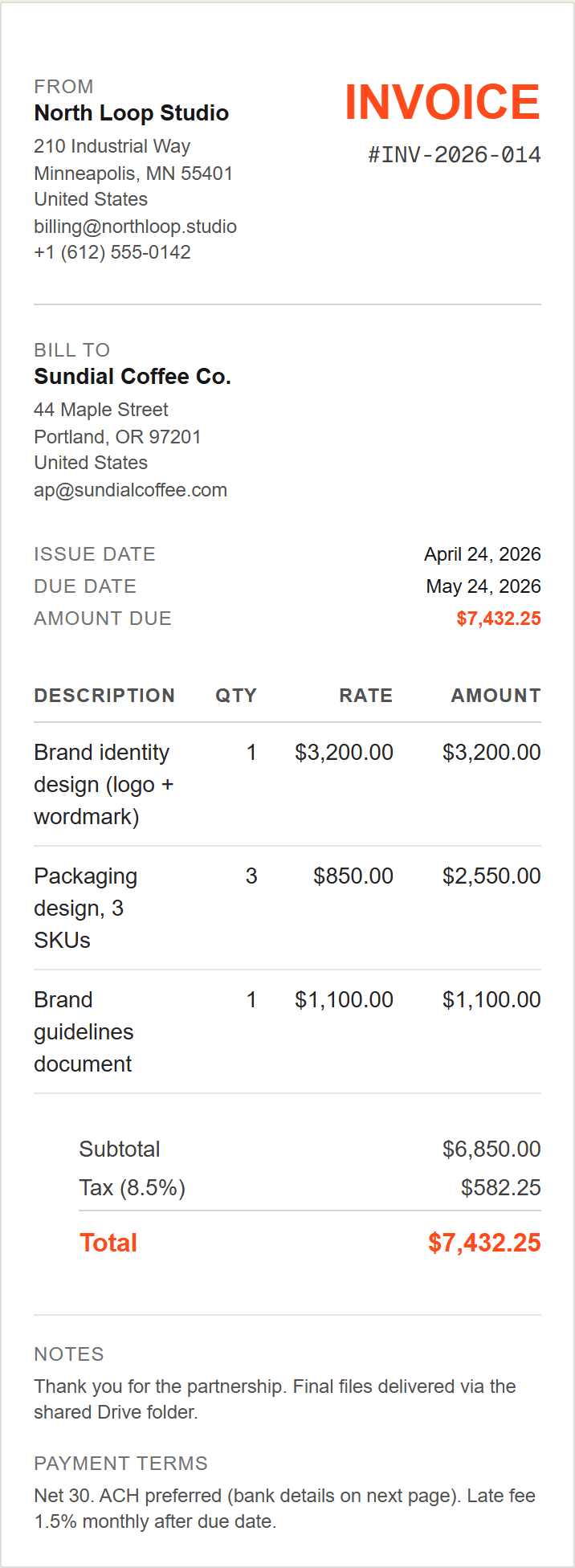
For freelancers invoicing a handful of clients a month, the software subscription isn't worth it yet. Our free invoice generator handles everything on this page: all 9 required fields, 10 currencies, tax/VAT/GST lines, sequential numbering, three templates, and PDF export. Data stays in your browser, so you can use it for client work without wondering where the data goes. If you outgrow it, every freelance tool listed above imports your existing invoice history.
Also worth bookmarking: freelance rate calculator to figure out what to charge, NDA generator for client confidentiality, and email signature generator so your follow-up emails look like they're from a pro.
FAQ
What should a freelancer invoice include?
Nine items are non-negotiable: your legal name and address, client's legal billing name and address, unique invoice number, invoice date, due date (or Net terms), itemized work (description + quantity + rate), subtotal and total, payment methods accepted, and your tax ID (EIN / SSN / GST registration / VAT / ABN depending on country). Skipping any of these usually means the invoice goes to AP review for another two weeks.
What payment terms do freelancers typically use?
Net 15 or Net 30 are standard. Net 15 is aggressive, good for established clients or recurring work. Net 30 is default and what most enterprises are set up to process. Net 45 or Net 60 is common from Fortune 500 clients but is slower than you want; negotiate shorter terms before the engagement starts, not after the invoice is late. For new clients or small jobs, 50% deposit upfront + 50% on delivery avoids the whole problem.
Do I need an LLC to invoice as a freelancer?
No, you can invoice as a sole proprietor under your legal name using your SSN (US) or SIN (Canada) as your tax ID. An LLC or incorporation becomes worth it around $40-60K/year of freelance income for liability separation and tax optimization, but plenty of successful freelancers never incorporate. The client's AP system usually doesn't care; they just need a W-9 and a consistent legal name.
How do I handle sales tax / VAT / GST as a freelancer?
Depends on country and service type. US: most freelance services (consulting, writing, design) are not taxable in most states; physical goods and some digital services are. Canada: GST/HST applies on most services above the $30,000 annual small-supplier threshold. UK/EU: VAT registration required once you cross the threshold (£85K in UK, varies by country in EU). Australia: GST applies on sales over $75K/year. When in doubt, check with an accountant for your first year, mistakes compound if you're collecting tax wrong.
What's the best invoice format for freelancers?
PDF is the answer. Every client's AP system processes PDFs. Word documents look like they can be edited and make AP nervous. Spreadsheets get printed weird. Plain-text emails often miss the attachment. Make the invoice a PDF, attach it to an email, include the invoice number in the email subject line, and include the total amount due in the email body, that way the client can act on it without opening the file.
How do I charge late fees as a freelancer?
Include the late-fee policy in your original agreement AND on the invoice itself. Typical: 1.5% per month on overdue balances (check your local laws, some jurisdictions cap this). Enforcing requires that the client saw the policy before the work started; surprise late fees rarely get paid. For small amounts, the threat of late fees usually works even if you don't actually charge them. For large amounts with repeat offenders, a clause about paying collection costs protects you more than the fee itself.
What do I do when a client doesn't pay?
Four-step escalation that works: (1) friendly reminder at 7 days overdue, assume the invoice got buried, ask for an update; (2) firmer reminder at 14 days, reference the agreed terms and mention the late fee clause; (3) formal demand letter at 30 days, via email AND physical mail, with a specific payment deadline; (4) last resort at 45-60 days, small claims court (US: up to $10K typically; Canada: varies by province) or a collection agency if the amount justifies it. Most unpaid invoices resolve at step 1 or 2, it's usually process failure, not malice.
Should I use invoicing software or a free tool?
Free tool if you invoice fewer than 5 clients/month or do one-off projects. Our free invoice generator handles everything most freelancers need, custom branding, 10 currencies, tax fields, PDF export, and never uploads your data. Invoicing software (FreshBooks, Bonsai, QuickBooks, Wave) becomes worth it when you start sending more than ~10 invoices/month, need automatic payment links (Stripe/PayPal integration), need client portals, or want time tracking tied to invoicing.
Do freelancers need to keep invoice copies for taxes?
Yes, and in more detail than most people realize. US/Canada: keep for 7 years (the IRS/CRA can audit that far back). UK/EU: 6 years typically. Store both the PDF you sent AND the record of payment (bank statement, receipt). A cloud folder with a consistent naming scheme (YYYY-MM-ClientName-INVXXX.pdf) is enough; dedicated invoicing software does this automatically. If you're audited and can't produce an invoice, the related income may be reclassified as unreported.
Related
- · How to make an invoice, the generic version, if you're not specifically freelancing.
- · How to invoice a client (first time), first-invoice playbook.
- · Invoice vs. receipt vs. bill, the difference in plain English.
- · Free invoice generator, the free tool itself.